How to try, fail, learn, repeat until you succeed and deliver in time?
There are some great phenomenal designs out there in the world. The core insight for product designers is that speed to market isn't about cutting corners on design quality - it's about getting your design hypotheses in front of real users as quickly as possible so you can learn what actually works and iterate based on genuine usage patterns rather than assumptions. Design patterns, interaction paradigms, and user expectations shift constantly as new technologies emerge. What feels innovative today becomes baseline expectation tomorrow. Designers must ship quickly to validate concepts before market expectations move beyond their solutions, or competitors establish new standards that make their approach feel outdated.
No matter how polished a design looks in prototypes or how well it tests in controlled environments, it creates zero value until real users can access it to solve actual problems in their daily workflows. The most beautiful unused interface is worthless compared to a functional solution that people actually adopt. While working with Flo for Partners feature, a partner app for women where they can share their cycle data with their trusted partner, we knew we were up for a huge challenge designing almost a new app. We were also aware it was a feature that was sure to make it sooner in other apps as well, therefore we really needed to beat time to market.
So, how do you set yourself, your team and your solution for success?
The key to any well executed outcome is to plan extensively. Time and again I have emphasised on the need for designers to partner closely with their product friends. It is the key to understanding and bridging the gap between expectations of the users and the focus of the business.
#1 Design quick proof of concepts:
This may sound a bit contradicting but one of the things I have realised into my design process successfully is to quickly have a hypothetical concept right in the planning stages in order to support the product vision and roadmap and to give a taste of what can be achieved. There are some amazing generative AI tools available today that can help designers create a concept for a perceived product vision.
#2 Time-boxed design sprint:
For more strategic projects or big bets, it can make a lot of impact to hold in-person 3-5 days design sprints however it needs a proper execution and a lot of pre-planning. Create timetable for each day accounting for every minute of every participant. Clear calendars, open minds and a bound space can do wonders for brainstorming sessions.
Defining outcomes from each session helps everyone understand the common goal we work towards and is helpful in aligning expectations. There is an enormous portfolio of tools and tactics to employ from different sessions, like using the opportunity solution tree or the crazy 8s depending on your requirements.
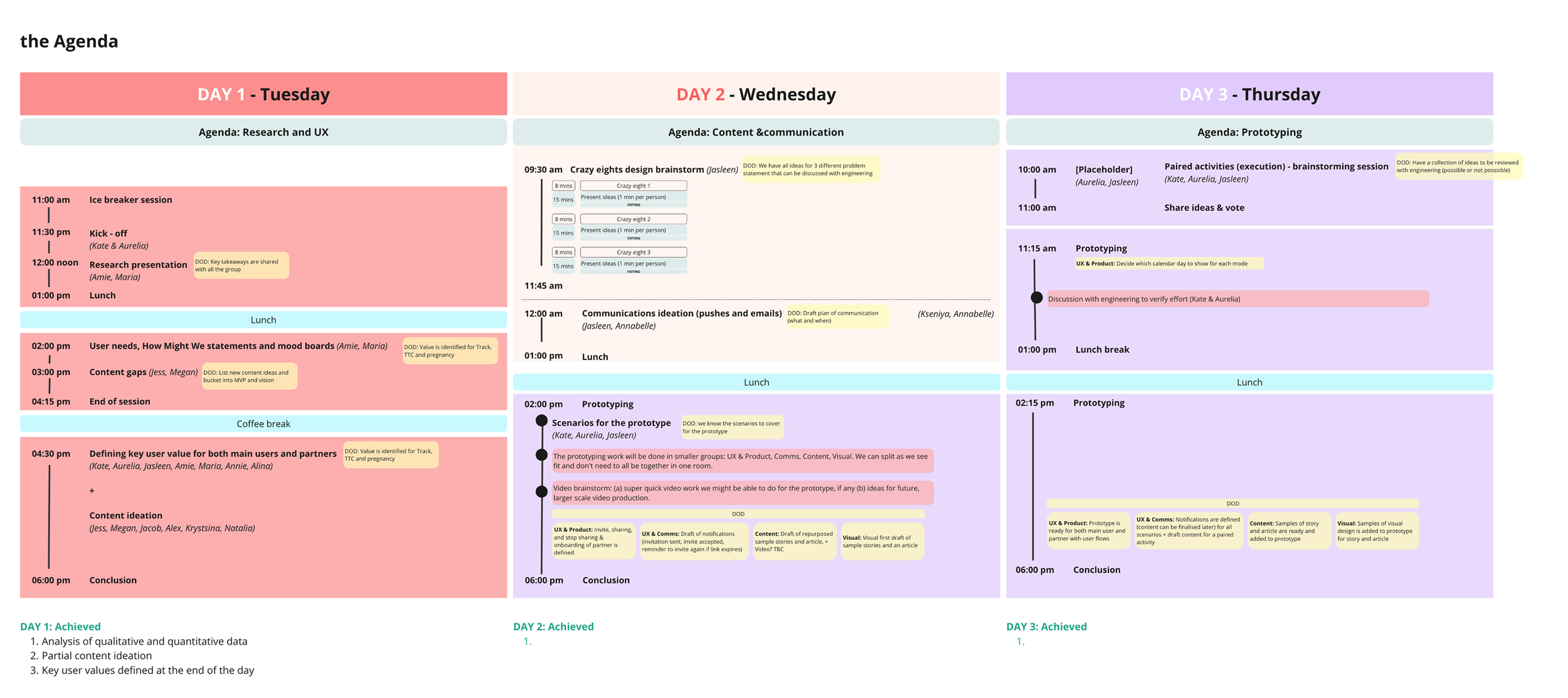
Pre-planning for a design sprint
#3 Quick testing:
This step is a must and most critical in order to reduce any risks. Aim for rapid testing with users and in parallel align with your product managers and growth marketing teams to check on employing strategies to validate concepts quickly. For example, doing a fake door testing with a social media post or if your product allows, testing in onboarding flow to measure engagement and interest in a new feature.
Be comfortable putting unfinished designs in front of your users. Conducting a user test with a low-fidelity prototype can help get early feedback and be considerable of them during designing.
#4 Define "good enough":
Establish clear success criteria upfront. What's the minimum viable experience that solves the user problem? This prevents endless tweaking and helps you recognise when you've reached a shippable solution. As a design team, have agreements in place to have a checklist of what you are comfortable having live in your product offering for a certain period of time. Sometimes it takes many months or years to revisit and MVP offering. Having such resolutions can support fast iterations.
#5 Refine early and then finalised designs with your engineers:
It can be of high value to have an initial refinement session with your engineering function with a flowchart of your user journey map or a low fidelity prototype with all scenarios in order to gather early insights on a ‘buildable solution’. After the ‘what’ you’ll get cracking at the ‘how’ with your developers.
Later, once the designs are ready, have another refinement with engineering in order to iron out any wrinkles. This helps in capturing early outliers and designing for all scenarios.
#6 Trust all functions:
A key differentiator of a great product shipped is the team that worked behind it. Great design reflects a highly collaborative and functional team where everyone strives to deliver more than expected but also support each other and unblock. They are transparent in their communication and everyone is informed. Teams that struggle in staying informed or transparent often fail to deliver their best.
In time deliveries do not mean launching mediocre designs, but delivering exceptional designs possible to make it to market first. Not succeeding doesn’t mean failing. It means you’ve identified a way it won’t work. Keeping users at the core and testing as much as possible is key to lessening the risk of failure.
Before the Flo for Partners launch, we went through 3 rounds of user testing and still made it in time as we never shied away from putting unfinished designs in front of our users.